

In May 2026 Deloitte surveyed 500 US private equity and corporate M&A leaders, and nine in ten said they use AI, including generative AI, in their M&A work to some degree. Only 37% use it across several deal stages, and the other users apply it to limited tasks or are still piloting it, according to Deloitte's 2026 Generative AI in M&A Pulse Study.
We found no comparable UK survey of dealmakers from a major firm or official body. The pages that rank in a search for AI deal sourcing are almost all written by vendors, and they describe what the tools could do far more often than what they have done. Anyone who has asked a language model about a small UK company has probably seen it produce a confident three-paragraph profile of a business whose only public record is a balance sheet and a registered office at its accountant's address.
A buyer working towards an owner-managed company passes through distinct stages, from written criteria to a conversation with the owner, and the evidence on AI differs sharply from one stage to the next.
Target screening is where M&A teams use AI most
Among the 465 respondents in Deloitte's 2026 survey who use AI, 74% said they use or pilot it at the stage covering portfolio strategy and the screening of targets and divestiture candidates. Diligence followed at 61%, and negotiation and signing came near the bottom at 33%. Use is heaviest where the work is reading and sorting, and among the lowest where the outcome depends on the other side of the table.
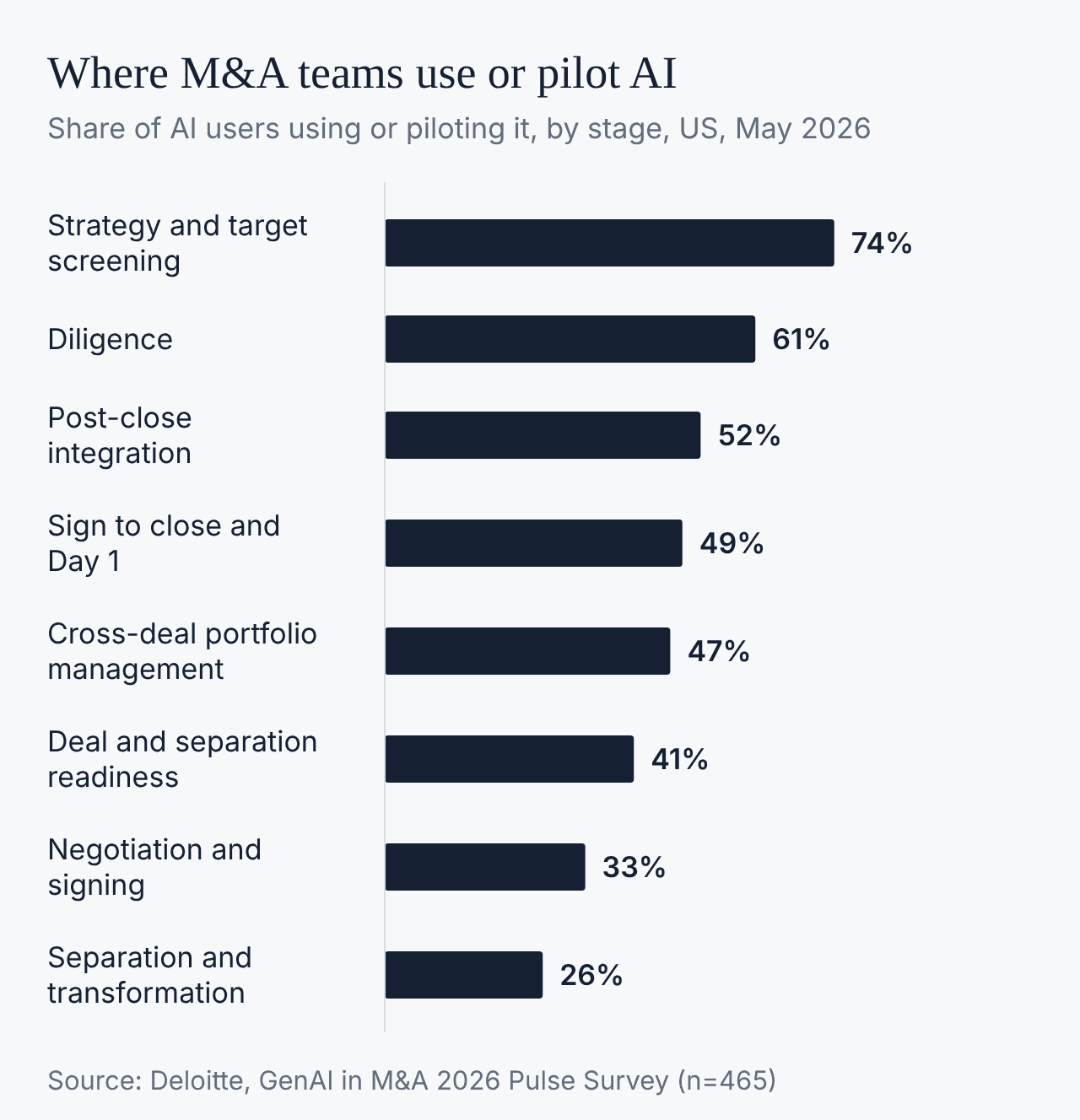
The chart counts AI users only, and its figures include teams that are still piloting. Deloitte put its question on risk to all 500 respondents, and it asked about the risks seen in using generative AI for deal governance. Of those respondents, 70% cited security or compliance concerns, and 67% cited unclear accountability for AI output or results that were inaccurate or inconsistent.
The survey covers only US respondents and relies on their own answers, which Deloitte says it did not validate.
The UK picture is broader and says nothing about dealmakers. In September 2026, 30% of all UK businesses told the ONS that they used at least one AI technology, with 29% of firms under 10 employees against about half of the largest firms. The owner-managed companies that buyers want to find sit at the lower-use end of that range.
AI deal sourcing fits the desk stages of building a target list
The first two of the stages of direct origination are setting criteria and mapping the market, and both are desk work. A language model can turn a written thesis into search terms and then read company websites to sort businesses by what they actually do. It can also test each company against the written criteria.
KPMG's June 2026 paper on private equity origination supports part of this. It credits AI with real strength in working through information that is already public.
Coverage has long been the sourcing problem, which is why a wider map of a market appeals. In 2017, Bain reported that a typical private equity firm sees only about 18% of the intermediated deals that could be relevant to it, citing a 2016 industry analysis of 110 firms. The figure concerns deals brought by intermediaries and predates generative AI, so it shows the size of the gap without saying that AI closes it.
KPMG's paper also says the tools depend on the underlying data, which can be thin or out of date, and that few private equity firms are yet using AI to find deals that others have missed. In the UK, small companies need not file a profit and loss account at Companies House.
Deal origination
We take one mandate per sector and geography, and approach owners before a broker does.
AI saves screening effort, and a fluent profile still has to be checked
In a KPMG survey of 150 private equity firms, published in December 2025 and reported by KPMG in June 2026, 80% reported up to a quarter less manual effort in target screening and prioritisation from generative AI, by their own estimate, and KPMG did not validate the figures. A further 16% reported minimal gains, and almost none reported more. The reported saving is modest, and it is a saving in effort.
In an experiment published by BCG in September 2023, 758 of its own consultants worked on set tasks, some with a generative AI model and some without one. On a creative task within the tool's capabilities, the group using it performed about 40% better than the group without it. On a business problem-solving task chosen to lie outside those capabilities, consultants using the tool did 23% worse, because many accepted output that was persuasive and wrong. The experiment studied consulting work, and it did not test deal sourcing.
A subsidiary taken for an independent business, or a company that has ceased trading, costs a buyer an approach, and a well-written profile makes such a mistake harder to spot. Deloitte's respondents seem alert to this, since review by functional experts was the condition they chose most often before relying on AI in a high-stakes decision.
Cheaper outreach makes an owner's attention harder to win
A language model can draft a personalised letter for every company on a list in an afternoon. When the cost of sending falls, owners receive more approaches, and a message that could have gone to anyone becomes easier to spot and easier to ignore, though none of the sources reviewed here measures that effect.
An owner reading a first message can test any claim of close knowledge against what she has filed herself, as a separate piece on how an approach looks from the owner's side explains. As AI spreads, a careless first message costs more, because an owner who has binned one generic approach is slower to open the next.
Automated profiling and messaging of named owners also fall under UK data protection and electronic marketing rules.
No dataset records which owners are ready to sell
Vendors describe scores that predict which owners will sell. An owner's intentions turn on her health, her family, a lost contract or an offer that arrives at the right moment, and, as the guide to direct origination linked above argues, none of these appears in a public record. KPMG's view that current AI cannot replace human effort and judgement in origination points the same way.
Signals such as an owner's age or a recent change of auditor may narrow a list, and a buyer working through 400 companies has to start somewhere. The open question is whether that narrowing beats the order the buyer would otherwise have used.
The available sources measure adoption, as Deloitte and the ONS do, or effort saved by the users' own estimate, as KPMG does. None of them measures whether AI-based sourcing leads to more deals or better ones. An owner's intentions usually come out in a conversation that follows a direct approach.
Cheaper lists leave the scarce parts of sourcing where they were
Our reading of the evidence is that AI is likely to make target lists cheaper and more complete. Accurate data on small private companies and the attention of their owners look likely to stay as scarce as before. More software solves neither problem, and the second gets harder as more buyers send more messages.
Identity verification for directors and people with significant control became a legal requirement at Companies House on 18 November 2025, and Companies House expected 6 to 7 million people to verify. The 12-month transition for people already registered in either role runs to mid-November 2026, about two weeks after this post appears. Every buyer, with AI or without it, will then have a better verified record of who controls each company.